Staff Training Week | SpainBcn-Programs in Barcelona
ICT Courses + AI
Specially designed for teachers interested in applying new technologies in their classes to also empower and support learning. We’ll go over the best apps, educational platforms, social networks and digital resources in general. Our new courses include a new focus on Artificial Intelligence, with educational apps and resources that use AI to enhance the learning and teaching experience. Our ICT courses are always tailored to the needs of our students, and the times now call for AI courses.
* NEXT SCHEDULED COURSES at this time:
Check open dates for this course in DATES tab
SpainBcn-Programs in Barcelona
OID: E10336106
Course fees
| Location | Course format | Fee |
|---|---|---|
| Barcelona | 20h/week | €400 per person |
| Barcelona | 25h/week | €450 per person |
| Other locations: Mallorca, Gran Canaria, Tarragona… | 20h/week | €450 per person |
| Other locations: Mallorca, Gran Canaria, Tarragona… | 25h/week | €470 per person |

To sign up, or for more information on specific courses, contact us at Hola@SpainBcn.com!
Weekly schedule
| Monday | Tuesday | Wednesday | Thursday | Friday | |
|---|---|---|---|---|---|
| Morning 09:00/10:00–14:00 |
Class | Class | Class | Class | Class |
| Afternoon | Free and optional tour | Free | Free | Free and optional tour | Free |
Evening tours may be cancelled or moved in case of weather, emergencies, or lack of participants.
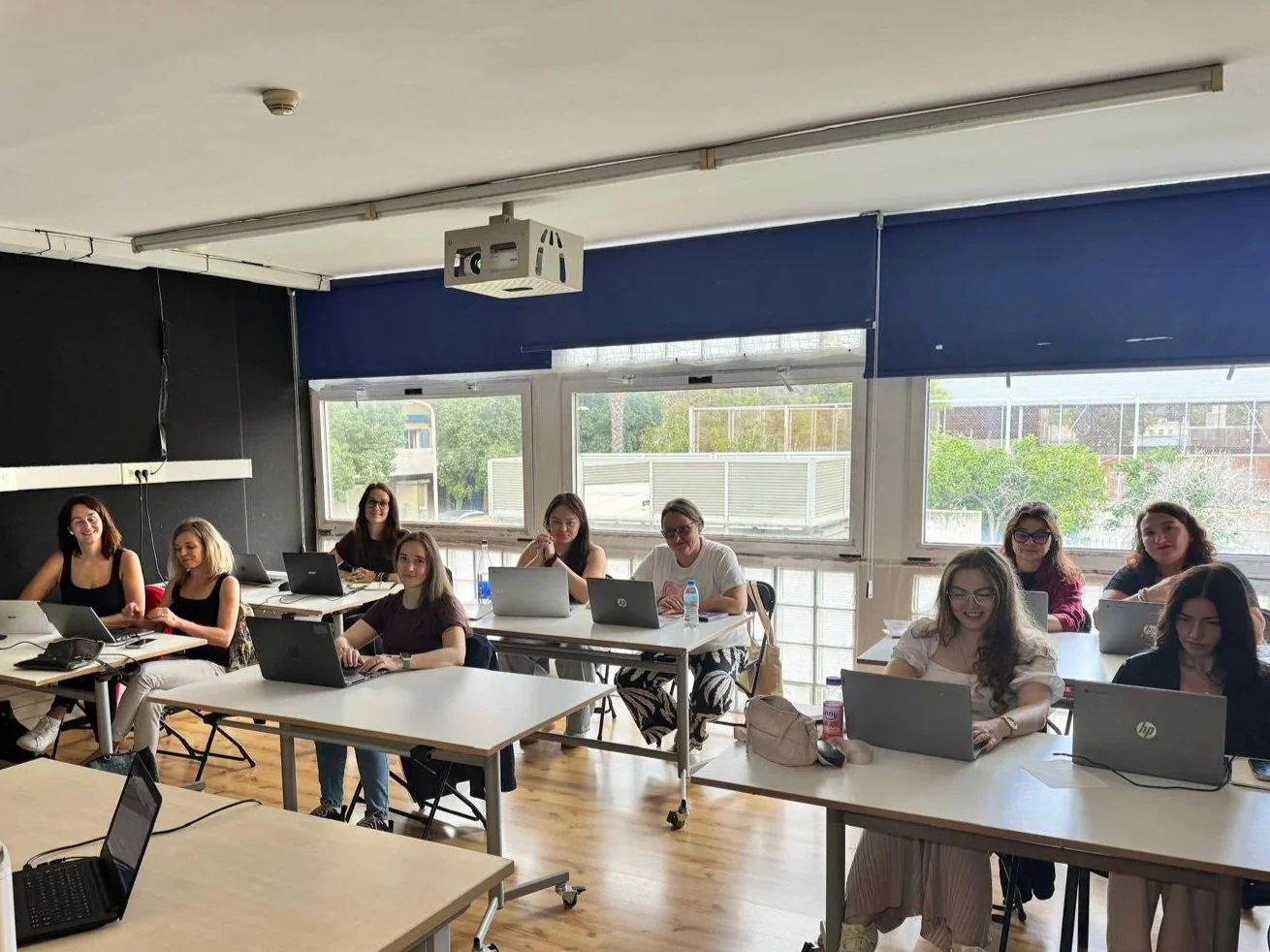
Group size: between 4 and 10 participants. Maximum 14
Group composition: Participants attend the course with an Erasmus+ grant or suing private funds, and come from a variety of European countries. This multicultural composition fosters intercultural exchange and peer learning.
Language of instruction: The course is delivered in English.
Schedule: The course is organized either from 10:00 to 14:00, from 10:00 to 15:00, or from 10:00 to 14:00 with two additional afternoon sessions or guided tours.
DESCRIPTION
This Erasmus+ training course is designed to support educators in developing advanced digital competences and an informed understanding of artificial intelligence (AI) within educational contexts. The course provides a structured and pedagogically grounded exploration of ICT tools and AI applications that can enhance teaching, learning, and assessment practices across a variety of educational settings.
The course begins with an examination of key digital educational tools that support effective teaching and learning. Participants will engage with interactive platforms, digital collaboration environments, online assessment tools, and multimedia resources, focusing on their pedagogical value and practical classroom implementation. Emphasis is placed on evidence-based approaches to digital integration, learner engagement, collaborative learning, and the development of critical thinking skills.
In the second part of the course, participants are introduced to the foundational principles of artificial intelligence in education. The course explores practical and ethical applications of AI, including lesson planning, instructional design, resource generation, and personalized learning. Participants will analyze how AI-driven tools can support differentiation, formative assessment, and basic automation of administrative tasks, while also considering issues related to data protection, transparency, and responsible use.
By the end of the five-day program, participants will have developed a comprehensive and transferable toolkit of ICT and AI resources aligned with contemporary educational frameworks. They will be equipped to critically evaluate and integrate digital and AI-based tools into their professional practice, contributing to innovation, inclusion, and quality enhancement in teaching and learning. The course supports educators in taking an active role in digital transformation and in fostering sustainable, learner-centered educational environments.
Be aware:
Participants are requested to bring their own laptop for use throughout the course, as all sessions include hands-on activities involving digital and AI-based tools.
LEARNING OUTCOMES
By the end of the course, participants will be able to:
Analyse and select appropriate ICT tools to support teaching, learning, collaboration, and assessment in diverse educational contexts.
Integrate digital technologies into pedagogical practice using learner-centred and inclusive approaches that promote engagement, collaboration, and critical thinking.
Demonstrate a foundational understanding of artificial intelligence in education, including key concepts, opportunities, and limitations.
Apply AI-based tools to support lesson planning, content creation, and basic personalisation of learning experiences.
Evaluate the pedagogical, ethical, and data protection implications of using digital and AI technologies in educational settings.
Design digitally enhanced learning activities that align with curriculum objectives and respond to learners’ individual needs.
Increase professional confidence and autonomy in the responsible and effective use of ICT and AI tools for educational innovation.
Transfer acquired digital and AI competences to participants’ own institutions, contributing to digital transformation and quality improvement.
ICT and Artificial Intelligence in Education (20–25 hours | 5 days)
Day 1 – Digital Education and ICT Foundations
Introduction to the course, objectives, and learning outcomes
Overview of digital transformation in education and Erasmus+ priorities
Key ICT competences for educators (DigCompEdu framework)
Exploration of essential digital tools for teaching and learning
Hands-on activities: interactive platforms and digital resources
Day 2 – Digital Tools for Collaboration and Assessment
Digital collaboration and communication tools in education
Designing interactive and learner-centred digital activities
Online assessment tools and formative feedback strategies
Practical workshops: creating collaborative and assessment-based activities
Reflection and discussion on classroom implementation
Day 3 – Multimedia and Inclusive Digital Learning
Using multimedia and creative tools to enhance learning experiences
Digital tools for inclusion, accessibility, and differentiated learning
Supporting student engagement and motivation through digital content
Hands-on workshops: multimedia content creation
Peer exchange of best practices and case studies
Day 4 – Artificial Intelligence in Education: Principles and Practice
Introduction to artificial intelligence and its relevance to education
Practical applications of AI in teaching: lesson planning and resource creation
Personalised learning and basic automation using AI tools
Ethical considerations, data protection, and responsible AI use
Practical workshops: experimenting with AI-powered educational tools
Day 5 – Integrating ICT and AI into Teaching Practice
Designing ICT- and AI-enhanced learning scenarios
Evaluating the impact of digital and AI tools on learning outcomes
Developing an individual action plan for classroom implementation
Presentation of participants’ learning projects
Course evaluation, reflection, and certification
METHODOLOGY
The course is delivered through a blended and participatory methodology that combines theoretical input with practical application. Emphasis is placed on experiential learning, enabling participants to actively engage with ICT and AI tools and to reflect on their pedagogical use in real educational contexts.
Interactive presentations are used to introduce key concepts related to digital education, ICT integration, and artificial intelligence in teaching and learning. These sessions are supported by guided discussions that encourage critical reflection, peer exchange, and the sharing of professional experiences across different educational sectors and national contexts.
Practical workshops form the core of the methodology. Participants work individually and collaboratively to explore digital platforms, AI-powered tools, and educational applications through hands-on activities. These workshops focus on task-based learning, allowing participants to experiment with tools, design learning activities, and immediately apply newly acquired competences.
Collaborative learning is fostered through group work, peer feedback, and project-based activities. Participants are encouraged to co-create digital and AI-enhanced learning scenarios and to evaluate their pedagogical effectiveness. Reflection sessions are integrated throughout the course to support self-assessment and the transfer of learning outcomes to participants’ own professional practice.
The methodology promotes inclusive, learner-centered, and reflective teaching approaches while addressing ethical considerations, data protection, and responsible use of digital and AI technologies. By combining theory, practice, collaboration, and reflection, the course ensures sustainable professional development and meaningful impact beyond the training period.
ASSESSMENT and EVALUATION METHODOLOGY
Assessment in this course is formative and continuous, focusing on the development of participants’ digital and pedagogical competences rather than formal testing. The assessment process is designed to support reflection, professional growth, and the practical application of ICT and AI tools in educational contexts.
Throughout the course, participants’ learning is assessed through active participation in practical workshops, individual and group tasks, and hands-on activities involving digital and AI-based tools. Trainers provide ongoing feedback to guide participants’ progress and support the achievement of the learning outcomes.
Participants are required to design and present a small-scale ICT- and AI-enhanced learning activity or implementation plan relevant to their professional context. This practical output serves as a key assessment component, demonstrating participants’ ability to apply acquired knowledge and skills in a meaningful and pedagogically sound way.
Self-assessment and peer assessment are integrated into the course through guided reflection sessions and collaborative discussions. These activities encourage participants to critically evaluate their own learning, exchange best practices, and consider strategies for transferring course outcomes to their institutions.
Course evaluation is conducted through participant feedback, reflective discussions, and end-of-course evaluation questionnaires. This feedback is used to assess the overall effectiveness of the course content, methodology, and organization, and to inform continuous improvement in line with Erasmus+ quality assurance requirements.
Upon successful completion of the course and active participation in all sessions, participants receive a certificate of attendance specifying the learning outcomes achieved and the total number of training hours completed.
CHOOSE YOUR COURSE
General ICT: ICT 100
School ICT (Focus: Gamification, AI, design, presentations…): ICT 101
University ICT (Focus: Research, AI, teaching tools, complex activities…): ICT 102
Artificial Intelligence - Learn all new aspects of AI, learn to apply them proactively: ICT AI
2 week ICT: ICT 200
ICT + language course: SPANISH&ICT / ENGLISH&ICT
WHO CAN TAKE PART
SCHOOLS: Educational Institutions, Primary-Secondary. Teachers, schools leaders, administration members and other staff.
UNIVERSITIES: Academic staff, teaching, nonteaching and administrative staff
LOCATION
Address: c/ Pare Lainez, 19–08025 Barcelona (Office).
* There are different school locations depending on the SpainBcn-Program or courses dates you attend. Contact us.
SpainBcn-Programs OID: E10336106
PROGRAM OPTIONS
20 hours of Class:
Classes from Monday to Friday from 10:00 am to 14:00 + 2 afternoon activities included (it is free and optional)
Learning material will be provided first day of class, according to the participants levels.
25 hours of Class:
Classes from Monday to Friday from 9:30 am to 14:30 or 10:00 am to 15:00 + 2 afternoon activities included (it is free and optional)
Learning material will be provided first day of class, according to the participants levels.
CLASSES and ACTIVITIES
Morning: Classes
Afternoon activities: Guided visit and Historical Route in Gothic and Medieval area in Barcelona, museums... Cultural activities are optional and free.
COURSE FEES (per person including all material + 2 Extracurricular activities (free))
COURSE FEES in Barcelona
20h/week: €400 per person.
25h/week: €450 per person.
COURSE FEES in Other locations (Mallorca, Gran Canaria, Málaga, Tarragona…)
20h/week: €450 per person.
25h/week: €470 per person.
If the course dates have to be postponed/changed due to an emergency situation, the fees paid will be valid for any other course offered by SpainBcn-Programs during the following 12 months.
FINANCIAL SOURCE
You can use any of the financial sources offered by your University, Erasmus+ Programs (or private, depending on your possibilities).
This course is included in the Erasmus+ programme.
SpainBcn-Programs' OID number: E10336106
CERTIFICATION OF ATTENDANCE
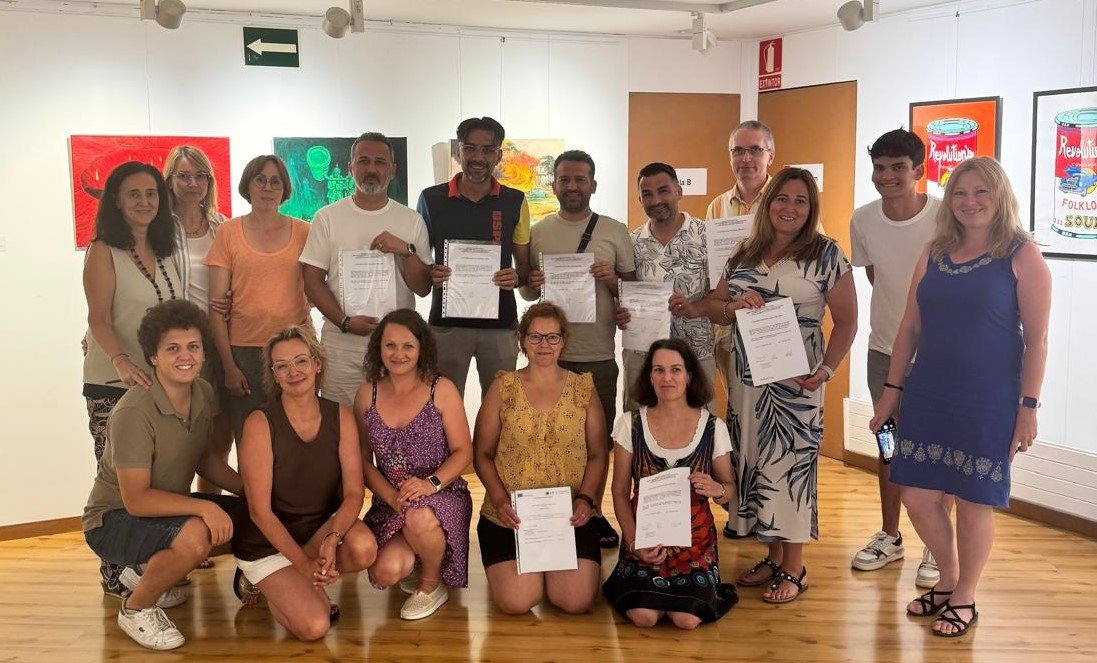
We will provide a Certificate of Attendance with description of training content, time input and achievement.